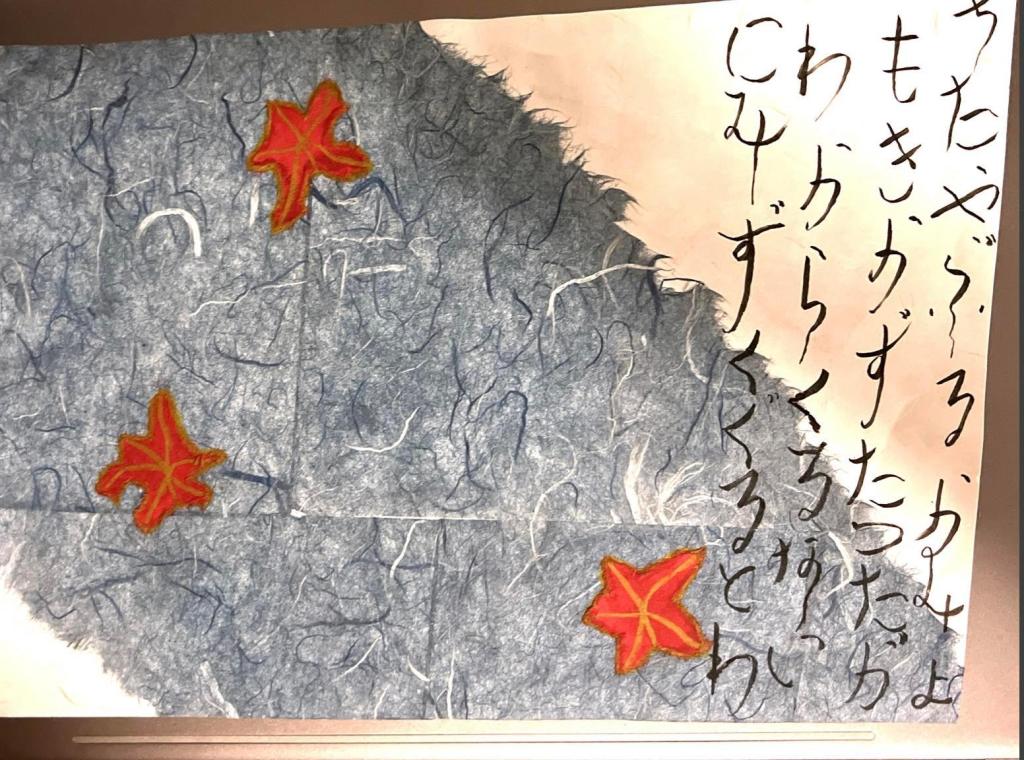
Chigiri-e waka – Japanese calligraphy poetry scroll on a collage page
Medieval Japan had a strong literary tradition of poetry, fiction and drama. Some of these works were even written by female writers. I have created a scroll in this tradition, using the elements that the same writers used at this time.
What I have made is a copy of waka poem from the Ogura Hyakunin Isshu collection written in tradition of onna-de. This I have written on aon a chigiri-e which I have made with washi paper. In the following paragraphs I will explain all these terms and then I will explain how I constructed my scroll.
Japanese waka poetry is the ancestor of the modern haiku and it has a long history going back as far as the 8th Century CE with numerous revivals of its use after this. Waka poetry was first written by women who would write in flowing calligraphy known as onna-de, “women’s writing”, which eventually became the writing system hiragana. This flowing style of connecting the characters in sweeping flourishes and loops is known renmen.
The text that I have used is the Ogura Hyakunin Isshu, translating to One Hundred Poets, One Poem Each; which is an anthology of waka poems compiled by the poet Fujiwara no Teika in the 12th Century. The poem I have chosen to copy is by the the notable poet Ariwara no Narihira from the 9th Century CE. It is the 17th in the collection and translates to English as:
Impassionate gods have never seen crimson that lies in the Tatsuta River.
This poem is perhaps one of the best known in the anthology. It depicts natural autumn scenery, that of red maple leaves that have fallen into the Tatsuta River. There is also another reading which makes it more personal to the poet himself. Apparently Ariwara no Narihira was in love with a lady named Fujiwara no Takaiko, yet due to their difference in rank their love could never be realised.
Poetry could be written on square tablets called shikishi, in collated rolled handscrolls and bound into books. Poetry in handscrolls and books were often elaborately decorated with metallic powder, paintings, marbling with ink and collages made from cut and torn paper known respectively as kiri-e and chigiri-e. Chigiri-e dates to the 10th Century and is a collage that uses torn, handmade paper glued onto a page to imitate watercolour paintings. These could take the form of patchwork, known as tsugigami, or imitating natural landscapes. They often were further decorated with paintings and ink drawings.
A chigiri-e is traditionally made with Japanese handmade paper known as washi. Paper first came from central China and arrived in Japan sometime before the 7th Century CE. Production of washi eventually became a local industry, first made by Buddhist and Shinto temples and professional papermaking guilds and then became much more widespread. Most washi is made by using the pulp of mulberry trees (kozo), but could also have fibres of bamboo (take) or hemp (asa) embedded on the page. Washi was bleached, traditionally using wood ash, and could be left white or coloured using plant-based dyes.
Now I have established the background, I will go into how I created my own scroll.
I made this scroll with a particular image in mind, using the torn paper to create the effect of red maple leaves on a stream. To make this I used a supply of washi paper I already had. This paper made by the Japanese company, the Awagami Factory, makes washi paper using traditional techniques. This paper is made using mulberry pulp and some of them use several different techniques. The blue and white paper has fibres embedded into the surface, the white paper has metallic fibres and the blue paper likely with hemp. To create the shapes, I used a paintbrush with water to draw guides for where I would tear the paper. To glue them onto the page I used a solution of diluted PVA glue which I applied with a sponge. I did the first later of blue paper first, having the pieces go over the page and applying several coats of glue top and bottom. After I applied the leaves, I needed to wait about eight hours for the entire work to dry and then I cut the loose bits of paper over the edges. I then used a gold calligraphy brush pen to outline the leaves and draw the veins. I needed to do several coats to get the right effect as the paint was absorbed by the paper.
I would next like to talk about the text of the poem itself. The translation that I used also provided a translation in Romaji, which is using the Latin alphabet to write the Japanese language. From this I consulted a hiragana chart to transcribe the text as well as a stroke order chart. I consulted modern resources for this rather than period ones and I made several practice copies before I made the final one. The practice gave me the opportunity to experiment with forming the characters, which ones would work well combined and how best to elongate. To do this I used Japanese calligraphy brush pens which are specifically made to practice Japanese calligraphy with.
In hindsight, I know I can improve in several ways on this piece.
Firstly, I was let down by the size of my pieces of paper, this led to join lines and gaps on the page. In future I will try to find larger pieces, or find a way to make join lines less obvious.
Secondly, I would like to use a better quality of pen in a future piece, at least before moving on to using a real ink and brush. I have since found better pens with a brush tip, this will no doubt help me practice.
Thirdly, I used more modern resources to refer to for my script, ones I found readily available online as my research priorities were elsewhere. In future I would like to make my script more like the traditional scrolls and less like modern Japanese. Also my calligraphy could use more practice, I was pleased with the result but there is almost room for improvement.
The last one is I used a modern glue rather than making a more historically accurate rice paste glue. This is largely due to my current living situation, but in future I would like to use rice paste glue and see what sort of results it would get.
Resources Used
Awagami Factory, https://awagami.com/, retrieved 24/1/2021
Barrett, Timothy, Japanese Papermaking: Traditions, Tools and Traditions, New York, 1983.
Hughes, Sukey, Washi: The World of Japanese Paper, New York, 1978.
Inenaga, Saburo, Painting in the Yamato Style, New York, 1973.
Integrated Collections Database of the National Museums, Japan, https://colbase.nich.go.jp/?locale=en, retrieved 15/2/2021
Nakata, Yujiro, The Art of Japanese Calligraphy, New York, 1973.
“Ogura Hyakunin Isshu”, One Thousand Summers: Japanese Literature Talk, https://onethousandsummers.blogspot.com/p/chouyaku-hyakuninisshu.html retrieved 24/1/2021.
Takenami, Yoko, The Simple Art of Japanese Calligraphy, London, 2004.
Yuzo, Yamane, Monoyama Genre Painting, New York, 1973.
 My Japanese Art Creations
Leave a comment